Sunday, January 15, 2012

Sat., Jan 14

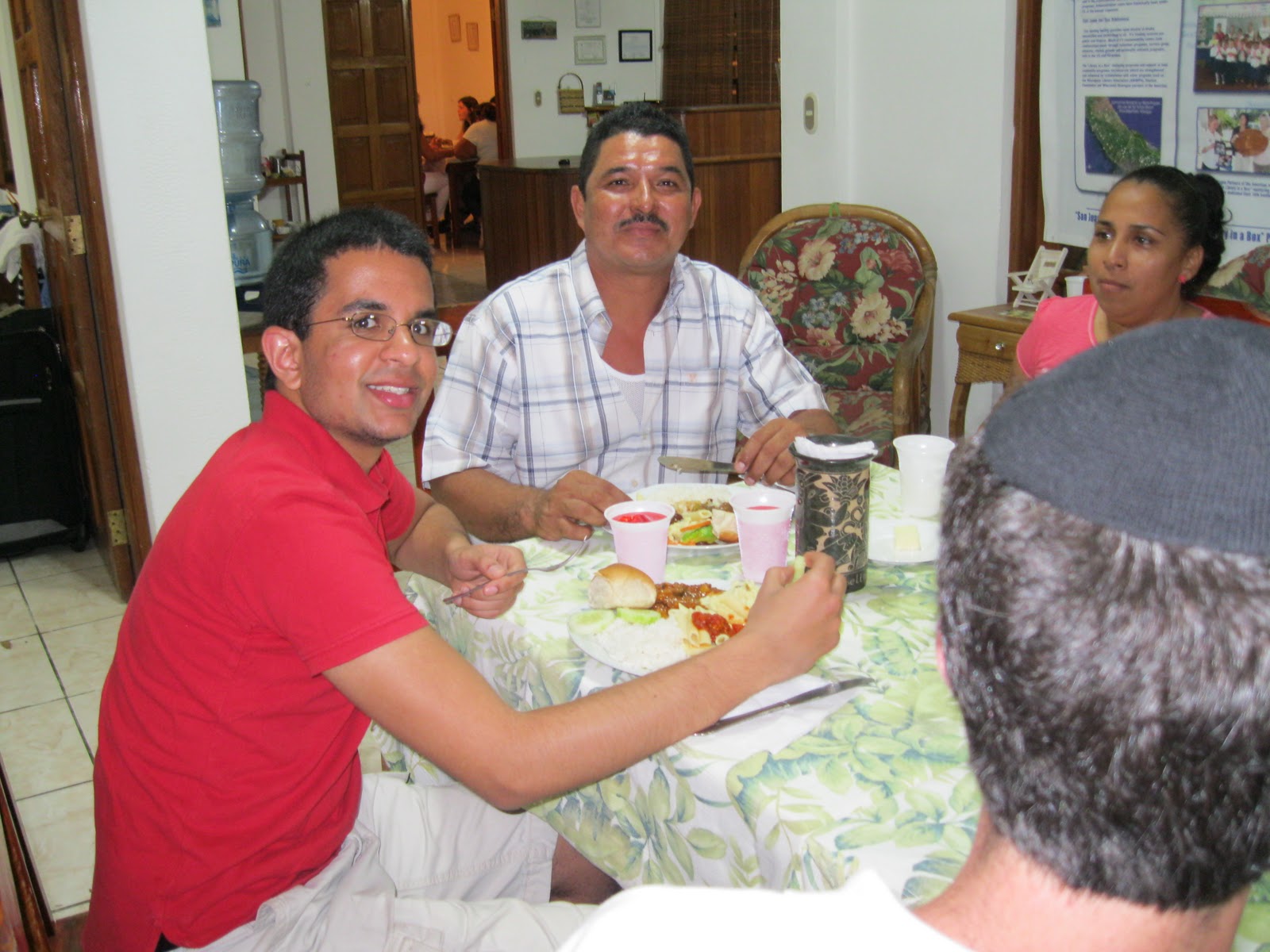
Dinner at Calibri with Lily, Zaida, Michael Roche (sponsors Leonel's microfinance operation), Pat, Jane.  In back, Rachel and Lee Greenberg and Sue

Dillon, Chelsea, Stephanie, Pratik, Dipti, Leslie with the restaurant owner

Matt, Amiel, Josue from UAM, Nikita, Carmen, Sandhya

Friday, Jan 13


From Dillon

Hola from la playa in San Juan del Sur! As I type this, I am sitting on the beach and watching the waves crash and the sun set on the horizon. Today was, without question, my favorite day in Nicaragua. We all woke up early today to get a head start. This was difficult for many of us who decided to stay up late last night playing charades, in which the guys handily defeated the girls). After eating a nutritious chocolate chip pancake breakfast in our hotel, Carmen, Amiel, and Sandhya left to paint Cecilia and Edwin’s new store. The rest of us loaded into Jane’s book mobile to bring books to rural school children.  The ride there was like a roller coaster. The streets through the mountainside were bumpy, and we had to cross through a few streams. We had to stop multiple times for cows in the middle of the street and we even got to see monkeys hanging out of a tree. Matt, Pratik, Chelsea, and Stephanie went to one school while Leslie, Dipti, Nikita, Zaida and I went to another.

Upon our arrival, we saw a small building with a basketball court and what looked like the remains of an old swing set. Next thing we knew, there was a group of 20 school children, ages 3-7, coming out to greet us. We wasted no time getting down to business. Leslie used her Spanish skills to read the children Llama Llama Rojo Pajamas. Once she finished that, we went around the room and colored pictures of llamas while the children eagerly checked out books from two large containers. It was rewarding seeing the smiles on each child’s face as he or she picked out a book. In America, many children don’t appreciate a simple book with all of the technology that’s out there. (i.e. http://www.youtube.com/watch?v=sv4Hpz-GI3g)   But in rural Nicaragua, these children acted like we had given them gold. I think this speaks to a greater lesson about the importance of cultural perspective.

Once the children had checked out their books, I noticed that a lot of the boys were going outside behind the building so I decided to follow them out. To my surprise, I found one of the older boys reaching into a hole in the wall and pulling out handfuls of live snails. All the boys proceeded to grab them and quickly slurped the defenseless snails out of their shells. They offered me one but I had to respectfully decline. To distract them from their snail habit, I offered them my camera. It was fun to see how excited they got over taking pictures. I then played tag with the group for the rest of my time there.  By the time we met up with the other group, I was both exhausted and exhilarated. This was definitely an experience that I’ll always remember.

For lunch we stopped at a local seafood joint. Good fish and shrimp dishes with lots of guacamole. After lunch, we finally got to go on our canopy tour. Essentially, it was a series of zip lines on top of a mountain. The ride up the mountain was a bit bumpy to say the least. Once we got to the top of the mountain we had an incredible view of San Juan del Sur. Next thing I knew, I was hooked on to the zip line and speeding down the mountain, hundreds of feet above the ground. It was one of the most exhilarating experiences of my life and I am happy to report that everyone survived.

After zip lining, we went to Dinner at Hotel Villa Isabel. My group’s micro-entrepreneur, Roxana, cooked dinner for everyone. Without question, it was the best dinner we have had in Nicaragua. During the dinner, we all had a chance to speak with our entrepreneur. We met Roxana’s family and made plans to move clothing shelves and racks into her house. When the dinner was over she even gave us a tour of her house so we could take the proper measurements. Our UAM teammate, Roger, is driving back to Managua to pick up our parts tomorrow and we will put them all in her house on Monday. A group of us are looking forward to exploring San Juan del Sur’s nightlife tonight. That’s it for now. Buenos noche y adios! 

Friday, January 13, 2012

Friday, Jan 13


View from the San Juan del Sur beach

Lunch, facing the beautiful beach - Pratick, Nikita, Dillon, Matt, Stephanie, Leslie

Jane's library - students went out this morning  with the bookmobile

Dinner with the entrepreneurs - Pratik and Edwin and Ana Cecelia.  All the entrepreneurs and their families were there for dinner.
Lily, Zaida, Ana Cecelia and Edwin

Thurs., Jan. 12

From Pratik:


Hola! I am currently sitting on the patio of our condominium in San Juan del Sor facing the bay and the mountains. The view from up here is so beautiful and very serene. This is truly the good life. Although, I must say, we had a bit of a disappointment all because of our dear Lily. The entire trip, she had led us to believe that we would be staying right on the beach, and when she realized on the bus that we were only twenty minutes away and that we couldn’t drop out of the trip at this point, she decided to tell us that the beach is actually thirty minutes away from here and that we’re just staying on the bay. It was quite the fun bus ride to hear her break the news to us, but nonetheless, there is no way that I can complain because the view from here is beautiful, the temperature is perfect, the water is so serene, and I’m sure everyone reading this at home is suffering from the cold weather.

Today was actually one of my favorite days of the trip so far, and I’m glad I get to blog about it. We started our day with a bike tour of Grenada (what better way to start the day?) We were originally supposed to leave in the morning for the tour at 9:30, but by the time our tour guide Frank got all the bikes out and lowered almost every single person’s seat, it was about 10:30. However, in retrospect, I have to say thank god we only started at 10:30. The sun was beating down quite hard and it’s definitely not the easiest thing to bike around Grenada while being mindful of all the traffic. We were all pretty tired by the end. The tour was really awesome though….we hadn’t really gotten a chance to truly check out the city and all that it has to offer, so riding a bike around was definitely a great way to get to know Grenada better. First, we biked to the lake (which I had no idea existed before we biked there) and the view there was absolutely beautiful. We biked with the lake to our left for quite some time, and it was just awesome to look left from time to time and see the water and mountains in the distance. We also got to see a lot more of the local life in Grenada, saw a lot of animals on the streets, and got honked at by probably thirty or forty vehicles which I can assure you gets quite annoying. Our tour guide’s name was Frank and he was definitely a really cool and good tour guide. I learned that there are actually 365 tiny islands in Grenada, and he took us out by one of them. He told us a great story about fisherman going out in the night to catch fish. He said that they go out around 1 or 2 AM and use only the moon and the stars as light. Hearing these kinds of stories really got to me because I think it’s great how simple of lives some of these people live. Coming from college park where there are so many lights and I can never lay outside and even see the stars because of this light pollution, it was awesome to hear a story like this and was very eye-opening. After stopping at this little island (and taking hundreds of pictures of course) we biked to some other spots in the city. The most intense part of the biking was definitely the fact that we were on some very busy, narrow, and crowded roads at some point. It was fun to coordinate the traffic and bike safely around the city while seeing the different sights. We finally got back at 12:30 exhausted but very pleased with the trip. As I stated, before this bike trip we really hadn’t gotten the chance to explore the city and see what Grenada was like, so it was definitely a good experience.

We were supposed to leave soon after getting back, so we grabbed lunch at Tip Top which is one of the most prominent fast food chains here in Nicaragua. They were all about fried chicken and French fries, but it was really good and the food felt really good after the long bike ride. After eating lunch, we got on the bus and headed to Juan Polina’s pottery store. This might have been my favorite visit of the entire trip so far. When we walked in to the store, we headed to the back where much of his family was located. His brother in law was sitting at the potter’s wheel. When we first entered, he was simply holding a piece of clay and molding it with his hands and was running the wheel with his legs. The next thing I knew, he was magically shaping the clay into a tall pot. Five minutes later, it was solidified and was being passed around to touch. I was so amazed by how quickly he did it and the fact that he seemed to have just put shape into this piece of clay magically. Juan Polina talked to us about all the different things that go into making his various pots, and he showed us pots at different stages in the process similar to how people do it on cooking shows. A lot of the stuff he told us about was so interesting, such as the fact that he uses his children’s hair to make the paintbrushes he uses, and also that he uses a toothbrush to flick water onto his pots. Before going to Juan Polina’s store today, I had been wondering what makes him one of the best known artisans in Nicaragua, but after this presentation I believe that it is pretty clear what separates him from artisans in the area. He pays such meticulous attention to detail (as evidenced by his paintbrush story) and he has a very good model running in his house currently. I think it helps him that it is a completely family run business, as everyone who was in his shop either making the pots or painting is a member of his family. Both his wife and he produce the pots, and his wife handles all the transactions. After his presentation to all of us, I’m pretty sure every single one of us bought one of his items because there were just so many great items.

After visiting with Juan Polina, we stopped briefly at a furniture store before taking off for San Juan del Sor. Almost the entire group slept on the bus ride there, and so Dillon and I were busy taking pictures of people at their finest. Let’s just say….we are not an attractive group of sleepers. After checking into Jane’s hotel, we headed out for dinner at El Timon. It was a really authentic experience as they had native dances and performances throughout the night before opening up the dance floor to everyone. We all did a little bit of dancing with Zaida, Pat, and Edwin before the night was over. Overall, today was a really fun day. I felt like I really saw some of Nicaragua today, and my eyes were really opened by the presentation that Juan Polina gave. Hope you all enjoyed reading about our day!

Wed., Jan. 11

From Sandhya:


The focus of today’s activities revolved around developing our business plans and pitching our suggestions and research for a panel of workers from Opportunity International, an international microfinance group that works with Nicaraguan artisans through its Ojala program. We closed the evening with a group question-answer session with seasoned Central American journalist and Boston-native Tim Rogers.
We spent about an hour working with our Universidad Americana matchups, perfecting our presentations for Opportunity International . Mildred, a local OI employee was available during this hour to talk to the groups and answer any of our Nicaragua-specific questions. I had a particularly nice time talking with her, learning about how different the Caribbean and Pacific coasts were. I was especially astounded to hear that the fastest way to access the predominantly tribal and Afro-Caribbean coast was by air or sea, given the poor condition of the inland roads and the density of the jungle towards the Caribbean coast.
My group did a general overview of microfinance, covering the basic types of loans, lending systems, benefits and downfalls of the systems and need assessment. The need assessment and loan screening process is the most difficult part of issuing micro loans, in my opinion. The definition of poverty varies so much from country to country; its seems almost oxymoronic to try and create a quantifiable system of measuring poverty when true poverty is not only measured by materiality and infrastructure but by the spirit of a community and the perception of “need.”
Our second presentation was on how OI could improve its operation in the US. Amiel, Carmen and Pratik went further and actually identified a successful business model, Ten Thousand Villages, which had the same type of supplier and consumer base. One of their suggestions, which definitely appealed to me as a supply chain major, was a shift in shipping patterns and inventory management. To mirror Ten Thousand Villages, the group suggested that OI reduce the number of shipments it makes to its American retailers and increase the size of its shipments. This would save shipping costs and reduce the time spent collecting and tallying inventory before it was shipped abroad. The group also suggested cause-based marketing that would appeal to consumers’ social consciousness. To implement this strategy, they suggested featuring one artisan/community on OI’s outlets’ websites every week. Simultaneously, the group suggested featuring a certain product at a markdown. By providing a detailed description of where the product had come from and who has made it, the advertisement campaign would have a more personable and intimate appeal.
The third presentation to OI was by Dillon, Dipti and Chelsea. The group talked about creating a solid business plan and identified forces and considerations OI would have to make as it expanded its network and Nicaragua. The main take-away points from this business plan were to create a 3-5 year outlook into the future in which the artisans could factor in the effects of their investments and project cash flows. I also thought their application of the four main forces of marketing (product, price, place, distribution)to the artisans’ business structure was important; a nuance of these individually operated small businesses is that they can price-discriminate so easily and a mark-up or a mark-down can be applied within seconds of meeting a customer. The group also touched on defining success through timelines, measurable goals, strategic alliances and sales forecasts. Some of the risks that should be factored into any business plan are the political, legal, environmental and demographic forces of a region.
The final group presentation for Opportunity International was by Stephanie and Nikita. The girls talked about a client growth assessment tool to identify current and future growth opportunities. The questionnaire for current growth opportunities would consider the history of the business, the time period and timeline for production, the creativity capacity of the artisan and how open the business is to change. Mildred from OI found the questionnaire for the business expansion in the future especially important because it would give OI a good picture of what kind of prospects the business owner had for his/her business, beyond what OI thought it could do to help the business.
Time Rogers, a foreign correspondent from the Miami Herald, came in around five to speak to us about his impressions on Daniel Ortega’s inauguration, which he had covered the previous day. I thought it was strange that the prince of Spain should attend the inauguration of a country that is trying to revive its leftist anti-colonial past, especially in the company of Hugo Chavez who is infamous for having publically insulted the former prime minister of Spain. It was funny to hear that Ortega insulted Ahmedinejad, perhaps his most high-profile guest, by suggesting that Israel should give up its nuclear weapons in exchange for Iran ending its nuclear programs and changing its stance towards Israel. Mr. Rogers then accompanied us to dinner at the Garden Cafe. I ended the night exploring the main square of Granada a bit, and managed to bargain 75 Córdobas off of a bracelet and a pair of earrings. 

Thurs., Jan. 12


Juan Paulino's pottery studio, with Zaida translating

It's a family business, with his brother in law (above), wife and other relatives working as well

Matt at the pottery shop

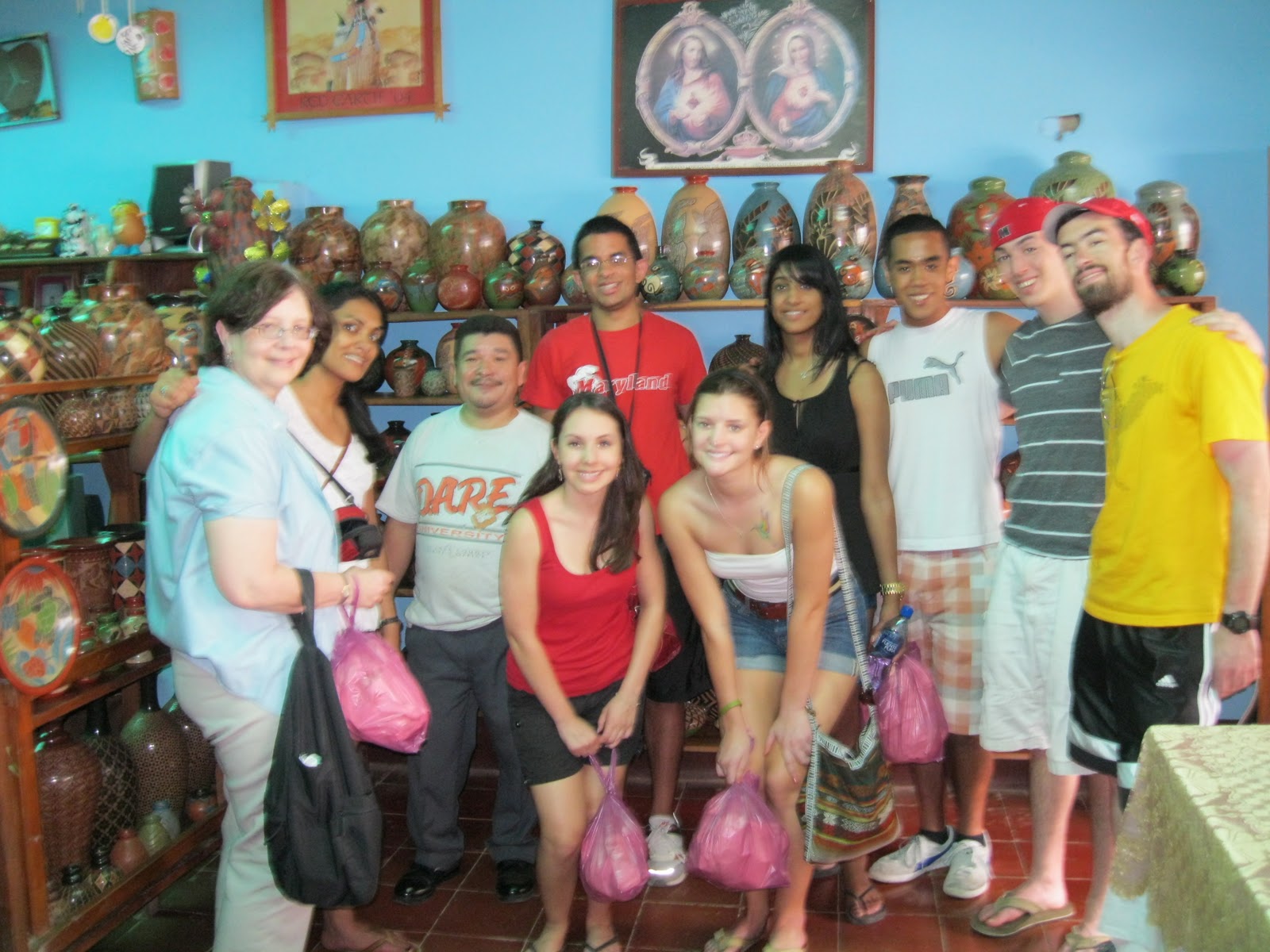
At the pottery shop

Dillon and Chelsea are checking out which chairs are most comfortable at the furniture factory


Dancers at dinner at El Timon

Thursday, January 12, 2012

Tues., Jan. 10 - Managua/Grenada

From Stephanie Chon:


Hola mis amigos!

Today marked a significant occasion in Nicaragua's long history of political turmoil. Nicaragua celebrated the inauguration of their President, Daniel Ortega, or as we like to call him, Danny. Iranian President Mahmoud Ahmadinejad and Venezuelan President Hugo Chavez, two of the most infamous leaders in the world, joined in on the celebrations here in Nicaragua. Unfortunately, due to the large rallies and possible dangers that could result from Ortega's inauguration, we decided to change our travel plans and leave the country's capital of Managua sooner than we had originally planned. We were unable to witness any major events in Managua because of the possibility that we may have not been able leave the area.

We started our day off with a visit to the Universidad Americana (UAM), which is the school that our Nicaraguan peers attend. We listened to a presentation given by Ricardo Terán Terán, the co-founder and managing partner of Agora Partnerships. Agora is a non-profit organization that invests human, social, and financial capital to accelerate the growth of high-impact entrepreneurs in the developing world. The organization works with small and growing businesses (SGB), which are commercially viable businesses, typically with 5-250 employees and strong potential for growth. It was really fascinating to learn about Agora since they are not a micro-financing organization, but still deal with entrepreneurs that impact underdeveloped communities.

After the presentation ended, we watched a brief video clip created by one of the UAM students about UAM and their international programs. We then got together with our group members from UAM to work on our projects for each of our assigned entrepreneurs. It was really interesting to see the campus layout structure, which was very open to nature.

The next stop was one of Nicaragua’s major banks, Banco LAFISE Central for a tour of their main office and a presentation about their experience in the micro-financing sector. We toured the building, seeing the different offices designated for each department as well as the cafeteria where all the workers can go to eat lunch. We noticed an abundance of art including large paintings and sculptures throughout the building, which are bought from galleries such as Codice: Galeria de Arte Contemporaneo y Artesania Nacional. One thing that really stood out to us was the number of female employees that worked at the bank. There is a great deal of gender equality, with a higher female to male ratio. We then listened to a presentation by a few of the bank employees, including one of the sons of bank owner and president.

In their presentation, they briefly discussed their current charity program with MIT of distributing free computers and setting up Wi-Fi connections for primary schools in extremely impoverished areas of Nicaragua. So far, LAFISE has helped distribute over 22,000 computers throughout Nicaragua and has already seen improvements in drop out rates as well as student attendance rates. They first select the school, Internet in school, and then work with local Internet companies that donate their Internet service to the schools. They then bring teachers to the bank in order to train them on how to use the computers for their teaching programs. After the presentation, LAFISE treated us to a nice lunch. We sat with the President’s son and other employees where we discussed more aspects of the LAFISE bank. At the end of our lunch, the President and owner and the General Manager came to greet all of us, which was actually very surprising. It’s not very often that company CEO’s and bank owners actually make an appearance for groups of students. Before we left, we each received gifts from the bank, which included a hat, a water bottle, and a pen, all branded of course, with the LAFISE name.

Our last stop in Managua before making our way to Grenada was the Masaya Volcano, which is Nicaragua’s first and largest National Park. As soon as we arrived to the volcano, there was a very strong smell of sulfur in the air that made it difficult for everyone to breath. We climbed up the steps to the top of the volcano to better see the depth of the actual crater. There is also a wooden cross at the top of the volcano put there centuries ago by the people to appease the Gods and keep the demons from escaping the volcano. Our friend from UAM said that the volcano is known as “the gates of hell”. We didn’t stay at the volcano for too long because it became too difficult to breathe after awhile. Before we left the Mayasa Volcano, we quickly walked through the museum in the National Park. I thought it was a really interesting contrast to the museums back home in D.C. The museum consisted mostly of pictures and models of the different volcanoes and nature in Nicaragua.

When we finally got to Granada, the difference from Managua was instantly apparent. Just from the cleanliness of the streets and the absence of visible slum housing and the bright and colorfully painted buildings. The city definitely has a historic colonial Spanish charm to it. Our hotel, Hotel Con Corazon is really beautiful with a very cozy and earthy atmosphere and feel to it. There are hammocks hanging in the main as well as a big wooden swing. One of the best aspects of the hotel is that it works with local artisans to help sell their products and they also incorporate artisan products in the hotel décor.

Our dinner in Granada was definitely one of the best experiences so far just from the bonding and memories that we made. We all headed out to the main strip where all the “gringos” go to dine. We ate at El Zaguan, where we were able to enjoy listening to two guitarists playing and singing Spanish songs, while we waited for our meals. The best part of dinner was when we asked the guitarists to serenade Lily with a Spanish love song, Besame Mucho. She was very moved by the song of choice because of the nostalgic feelings and memories.

We had an interesting walk back to the hotel. First, we saw a fairly large dead rat in the middle of the road and then we saw a man passed out in the middle of the square. We were worried that he was unconscious or worse until another concerned passerby came by and noticed that he was snoring. A couple of us had leftover food from the restaurant, which we were planning on giving to any children or people that we thought would eat it. As we were looking for people, we walked by two older women who began shouting at us asking and reaching out for the baggies of food in our hands. After handing them the food, they asked for our bottles of water to drink with the food.

We ended our night on a calm note with everyone just hanging around the hotel. Overall, it was definitely one of the best days we’ve had so far, but we’re all really excited and looking forward to getting to San Juan del Sur in a couple of days.